Dec 27, 2025
RHRC-The situation in the Cox’s Bazar camps is deteriorating day by day resulting in an insecure life of the Rohingya refugees while the humanitarian crisis in Rakhine is rising as well forcing thousands of Rohingya to flee Bangladesh and Rakhine in search of a secure life.
By late December 2025, widespread conflict, political exclusion, and humanitarian blockades had created an increasingly dangerous environment for civilians, particularly the Rohingya population.
The Myanmar Military Junta is proceeding with a controversial national election scheduled to begin on December 28, 2025. An estimated 600,000 Rohingya still living in Arakan have been completely excluded, as they remain denied citizenship and basic political rights. Most of the state is now an active conflict zone, making voting impossible in large areas. With the Arakan Army controlling the majority of townships, the military is limited to holding elections only in small, heavily secured areas, leading many observers to question the legitimacy of the process.
As fighting continues, the Myanmar military has expanded its use of air power to regain lost territory. Civilian infrastructure has been repeatedly targeted, including hospitals, schools, and clinics. On December 10, a major hospital in Mrauk-U was struck by an airstrike, reflecting a broader pattern of daily drone and aerial attacks. These assaults have resulted in the deaths of dozens of civilians this month alone, affecting both the Rohingya and the Rakhine communities.
Life Under New Control in Maungdaw and Buthidaung
With the Arakan Army now exercising control over Maungdaw and Buthidaung, Rohingya residents face new forms of hardship. Strict movement restrictions prevent people from traveling beyond their villages, cutting farmers off from their land and fishermen from rivers and coastal areas. The loss of livelihoods has significantly worsened food shortages, pushing many families toward hunger.
Reports from the region indicate that Rohingya men are being forced into unpaid labor by armed actors, including dangerous work near front-line areas. Some accounts describe civilians being used as human shields, placing them at extreme risk. These practices have increased fear and insecurity among already vulnerable communities.
Daily life is marked by constant anxiety. Many Rohingya feel unsafe even within their own homes, as they are frequently viewed with suspicion and accused of supporting rival forces. This atmosphere has led to arbitrary detentions, intimidation, and a deep sense of uncertainty about personal safety.
Across northern Rakhine, conditions vary but remain severe. Maungdaw is experiencing acute food shortages and heightened tension between armed groups and civilians. Sittwe remains under military control and has been transformed into a fortified base used for launching air operations. In Buthidaung, communication networks have been cut off entirely, while humanitarian agencies are blocked from access. In Mrauk-U, repeated airstrikes have damaged historical landmarks and medical facilities, weakening essential services.
International humanitarian organizations caution that northern Rakhine has become an extremely dangerous environment for civilians. Winter conditions, ongoing bombardment, and restrictions on aid delivery have combined to create what many describe as a “death trap.” With no safe exit routes and no secure places to remain, hundreds of thousands of Rohingya continue to face severe risks to their survival.
Rohingya families in Kyawktaw Township face worsening hunger, malnutrition crisis grips the community
Malnutrition is rapidly worsening in Kyawktaw Township, where severe food shortages are pushing Rohingya children to the brink of survival. Many families are surviving on little more than rice water, while parents watch their children grow weaker each day without access to adequate food or medical care.
Residents describe daily life as dominated by hunger and fear. A recent visit by a health team linked to the Arakan Army revealed the extreme lack of resources, as local volunteers showed the few basic medical supplies the community has been sharing for months. The visiting team reportedly appeared shocked by how little support families have been surviving on.
Arakan Army Seizes Rohingya Lands in Maungdaw, Constructs Rakhine Settlements
The Arakan Army (AA) has taken control of Maungdaw township in Rakhine State, Myanmar, and is reportedly taking over Rohingya villages, building new settlements for Buddhist Rakhine families, and redistributing farmland. This has led to concerns about the displacement of Rohingya people and potential ethnic cleansing. Reports indicate that AA and its administrative wing ULA are taking control of former Rohingya villages, including Nwar Yone Taung, Khawlizarr, Kyikanpyin, Wabut, Phar Wut Chaung, Myaw Taung, and Kyin Chaung. New settlements are being built for Rakhine families, with farmland being divided and redistributed. Rohingya families have been ordered to vacate their homes, sparking fears of renewed displacement and ethnic persecution.
The situation is raising humanitarian concerns, with tens of thousands of Rohingya displaced, many crossing into Bangladesh. Reports of AA committing atrocities, including forced conscription, arson, and killings, have emerged. International organizations are calling for urgent intervention and protection for Rohingya civilians. The situation remains volatile, with ongoing conflict and humanitarian concerns.
EU Allocates €15 Million for Humanitarian Crisis
The EU has allocated €15 million to tackle the severe food insecurity and malnutrition crisis in Myanmar, affecting vulnerable populations displaced by conflict. This funding aims to provide urgent assistance to those at risk of famine, ensuring basic needs are met amidst the crisis. The aid focuses on addressing the growing risk of famine and hunger, providing essential nutrition support, and ensuring access to food, clean water, and healthcare for displaced communities. This response is critical as over 12 million people in Myanmar face acute hunger, with around 1 million expected to reach emergency levels requiring immediate assistance.
UNHCR has welcomed China’s generous contribution of USD 2.5 million to support Rohingya refugees in Bangladesh.
UNHCR has welcomed a USD 2.5 million contribution from China to support Rohingya refugees in Bangladesh amid declining humanitarian funding. The assistance will provide liquefied petroleum gas (LPG) for cooking to about 458,000 refugees across 94,000 households until October 2026.
UNHCR said the support is vital as many life-saving programmes face funding shortages. UNHCR Representative Ivo Frejsen thanked China for its solidarity, saying the contribution helps restore dignity, improve safety, and reassure refugees that they have not been forgotten.
Since its introduction in 2018, the LPG initiative has ended the need for firewood collection, improving protection for women and girls, allowing children to attend school, and helping preserve surrounding forests. It has also reduced health and safety risks inside the camps.
China’s Ambassador to Bangladesh, Yao Wen, reaffirmed China’s commitment to supporting vulnerable communities, noting close cooperation with UNHCR and the government to ensure effective implementation.
Meanwhile, refugee community members say hunger dominates daily life, with children crying at night from lack of food. Elderly caregivers and parents say they are only asking for enough food and medicine to survive. Bangladesh currently hosts about 1.16 million Rohingya refugees who rely heavily on humanitarian aid, and UNHCR stressed that continued international support is essential to prevent the crisis from worsening.
UK & Qatar Pledge $11.2M Aid for Rohingya Refugees & Hosts
The UK and Qatar have jointly announced $11.2 million in funding to support Rohingya refugees and host communities in Bangladesh’s Cox’s Bazar district. This initiative will provide Liquefied Petroleum Gas (LPG) to over 647,000 vulnerable people, aiming to improve living conditions and reduce environmental degradation in the camps.
The funding addresses critical challenges, including improving household living conditions and reducing deforestation caused by firewood reliance. This support comes amid a severe resource shortage for Rohingya aid operations, with the UN World Food Programme facing a nearly $190 million funding gap.
The Rohingya crisis remains a protracted humanitarian emergency, with over 1.3 million refugees in Bangladesh and no successful repatriation efforts.
Rohingya Refugees Suffer as US Aid Cuts Lead to Child Marriage and Labour
US aid cuts have led to devastating consequences for Rohingya refugees in Bangladesh. With thousands of schools and youth centers closed, children are being forced into early marriage, labor, and even prostitution. Girls as young as 12 are being coerced into marriage, while boys are pushed into hard labor, leaving them vulnerable to exploitation and abuse. Hasina, a 17-year-old Rohingya refugee, was married off at 16 after her school closed due to funding cuts. She’s now trapped in an abusive marriage, with no escape. The situation is dire, with child marriage rising by 21% and child labor up by 17% in the year to September 2025. The UNHCR warns that the funding crisis threatens to undo years of progress, leaving an entire generation of Rohingya without protection or a future.
EU Pledges €14 Million for Rohingya Refugees
The EU’s €14 million aid package is a vital lifeline for Rohingya refugees, focusing on long-term sustainability and dignity. It’ll boost skills development, healthcare, water, sanitation, and education in refugee camps, helping people regain independence. This support is crucial as the humanitarian situation worsens with over 136,000 new arrivals since Jan 2024, stretching resources thin.
Rohingya Leaders Unite in Bhalukhali to Address Repatriation, Security, and Social Challenges
Camp 10, Bhalukhali — The Rohingya Committee for Peace and Repatriation (RCPR) held a large public meeting today in Camp 10, Bhalukhali, bringing together thousands of refugees to discuss the urgent challenges facing the community. The gathering began at 10:00 a.m. under temporary shelters and marked one of the largest community-led assemblies in recent months.
The meeting was chaired by RCPR Chairman Dil Mohammed, who emphasized the need for unity, discipline, and awareness at a time when both repatriation efforts and camp safety remain uncertain.
Focus on Safe and Dignified Repatriation
During his address, the Chairman reiterated that the ultimate goal of the Rohingya community remains a voluntary, safe, and dignified return to Arakan (Rakhine State), Myanmar. He stressed that repatriation must be based on full citizenship rights, international protection, and guaranteed security. Without these conditions, any return would place lives at risk.
Warning Against Human Trafficking and Dangerous Migration
The RCPR issued a strong warning against human traffickers who are exploiting poverty and desperation in the camps. Families were urged to remain vigilant and to protect their children from false promises of employment and safety abroad. The committee highlighted that many who attempt irregular journeys by land or sea face abuse, detention, or death.
Addressing Harmful Social Practices
The meeting also addressed internal social challenges, including early marriage and domestic violence. Community elders and household heads were urged to take responsibility in preventing these practices, which were described as serious threats to family stability, women’s wellbeing, and the future of children.
In addition, the RCPR clearly forbade all forms of gambling, including one-x-bet and similar activities, stating that gambling fuels poverty, family conflict, and criminal behavior within the camps.
Strengthening Camp Security and Community Cooperation
Rising concerns over insecurity were discussed at length. The committee called on refugees to cooperate with camp authorities, the Armed Police Battalion (APBn), and civil society volunteers to identify and isolate criminal elements. Unity and lawful behavior were emphasized as essential to maintaining safety and protecting humanitarian services.
Education, Health, and Reporting Mechanisms
The RCPR stressed the importance of education as a protective tool, encouraging families to keep children enrolled in learning centers to reduce the risks of early marriage and trafficking. The committee also noted ongoing efforts to improve safe reporting systems for suspicious activities while protecting those who come forward.
Recognizing the mental and emotional strain caused by prolonged displacement, the leadership urged peaceful conflict resolution within families and neighborhoods to reduce tension and violence.
“Our strength lies in unity. If crime and violence divide us, our voice weakens. Protecting our families today is the only way to secure our future tomorrow,” said Chairman Dil Mohammed.
Plans for Continued Outreach
The RCPR announced that this meeting is part of a broader “Peace and Awareness” campaign. Similar gatherings will be held across Kutupalong and Bhalukhali camps in the coming weeks to ensure consistent messaging and community engagement.
Arson Attack Destroys Malaysian Hospital in Camp 4
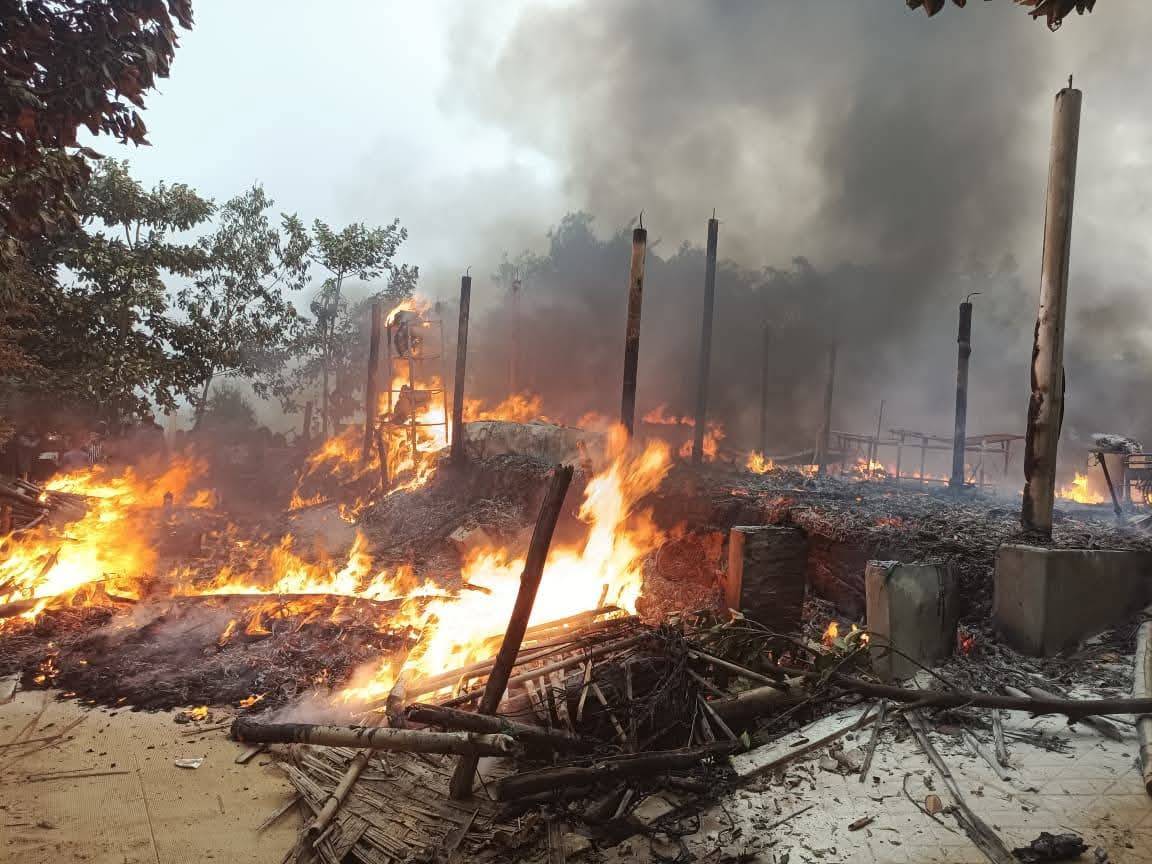
Camp 4 (Madhurchhara), Ukhia — A devastating fire, suspected to be arson, completely destroyed the OBAT Helpers Health Center, widely known as the Malaysian Hospital, early Friday morning, December 26, 2025. The fire broke out around 5:00 a.m. in Block D and rapidly engulfed the facility.
The hospital, a major provider of free healthcare for refugees and host communities, was reduced to ashes within minutes. Medical equipment, medicines, and essential supplies were all lost. Preliminary estimates place the damage at more than 100 million BDT. No casualties were reported, as the facility was unoccupied at the time.
Pattern of Fire Incidents Raises Alarm
The hospital fire followed another blaze just hours earlier in Block B of the Kutupalong Registered Camp, where five shelters were destroyed at around 10:00 p.m. on Thursday night. Although no lives were lost, several families were left without shelter during the winter season.
Community leaders and the RCPR expressed concern that the timing and proximity of the incidents suggest deliberate attempts to create instability and disrupt essential services.
Emergency Response and Demands
Firefighters and volunteers battled the Camp 4 blaze for more than two hours before bringing it under control. Investigations are ongoing. The RCPR has called for increased night patrols, a transparent investigation to identify those responsible, and urgent temporary medical facilities to replace the destroyed hospital.
Residents with information about suspicious activity near Block D before the fire were urged to report it to their Block Majhi or the Camp-in-Charge office.
The mega-camps are also facing a deepening humanitarian crisis. Aid agencies have reported a severe funding shortfall for 2025–2026, leading to reduced food rations and shortages of shelter materials. New arrivals are struggling with overcrowded and unsafe living conditions.
At the same time, increasing numbers of refugees are attempting dangerous sea journeys, driven by insecurity and hunger. Traffickers remain active, particularly in Camps 10, 11, and 12, prompting renewed warnings from the RCPR to parents and community leaders.
Reports also indicate rising threats against community leaders and volunteers, along with increasing domestic violence and child marriage. The RCPR has described these issues as a “silent crisis” that requires urgent attention alongside security threats.